After a very wet week, this morning was sunny and cheering. By 8.00 there was a Common Blue in the burial ground meadow and a Hare finding the cover of the growing herbage to it liking.
Hare
Although there is some False Oat-grass Arrenhatherum elatius now becoming evident, I’m sure (as I can be for now) that it has reduced dramatically from last year and that Soft BromeBromus hordeaceus has increased dramatically. There is still plenty of variety including some decent patches of Hay-rattleRhinanthus minor.
Hay-rattle
The early brightness soon broke but for a while around noon, there was some break in the cloud and I grabbed the opportunity to do this week’s butterfly transect. It finished in a splashy rain shower and managed one butterfly – a Small White!
In a very soggy moth trap, there were enough dry niches in among the egg trays for there to be 33 dry moths of 10 species – the best result since 21st March! They included my 6th ever Green Arches and the first Coronet of the year.
Green ArchesCoronet
All my Coronets look like this; they are big WL 19mm (the high-end of the range given in Waring et. al. and a lot bigger than those illustrated in the first edition) suffused with green and with much reduced white highlights. So it is reassuring to see a new plate in the 3rd edition showing a bigger moth with something resembling these characters and a revised text saying that this form is prevalent in the Midlands. The provisional atlas (2010) shows its distribution as mainly southern England (south of Bristol -London) and south Wales with a very patchy distribution elsewhere. I had my first here at Keyworth in 2011 and they have become steadily more numerous (95 in 2017 and 74 in 2018).
We were hard pushed to get a day out this week given the very unsettled period with much heavy rain but today’s rain was gentle enough (for much of the day) to allow note-taking.
Caucasian Stonecrop
It’s perhaps a bit questionable whether this one is legitimate as a wild plant in this location given that gardens weren’t too far away but the decision was made and Sedum spuriumwill appear in the atlas for this square; many others are not allowed in but there’s no doubt about Cerastium diffusum growing along the salted kerbside given its unexciting form – hardly a garden escape.
Sea Mouse-ear
Once again it was Dave’s lengthy experience that detected the jizz of this difficult species though samples are now under the microscope for confirmation. There was lots of it, with a similar population of Fern GrassCatapodium rigidum along the verges of Park Lane.
Later on we found lots of SalsifyTragopogon porrifolius – Goatsbeard but with blue flowers – and only the second population I’ve come across (the first was one plant – this one was well into double figures).
Salsify
This happily moist moss is, I am assured, Homalothecium sericeum (Silky Wall Feather-moss)
Silky Wall Feather-moss
Later in the day the gentle drizzle became wetter and a walk along a wild public footpath was drenching from the thighs down but on our return via Hungary Lane the ‘odd’ sounding Chiffchaff we had heard earlier gave a flourish of stuttering Willow Warbler – a hybrid surely!
Willow Warbler x Chiffchaff
Well, maybe not. It seems that some Willow Warblers go ‘chiff-chaff’ when they’re hacked off. Perhaps this one was just fed up with the weather.
Before the forecast rain set in around 11am, I made a plant inventory of our sown wildflower meadow. I wish I’d done this annually since it was created as its ups and downs are so pronounced that I am losing track of them via the casual basis of my recording. You can read more about it on the Keyworth Meadow website but basically it started badly in 2012, was outstanding in 2013, slowly deteriorated (despite ideal management – thanks to Norman Davill, our neighbouring farmer) and in 2018 looked to be a dead loss.
However over the past winter, Norman’s sheep have done a grand job and they were allowed to stay until mid May. Now it seems, the False Oat-grass, so dominant last year, had been magicked away and most of the desirable herbs are still there. A few more years of late summer haymaking and winter grazing should see it improving still further – fingers crossed.
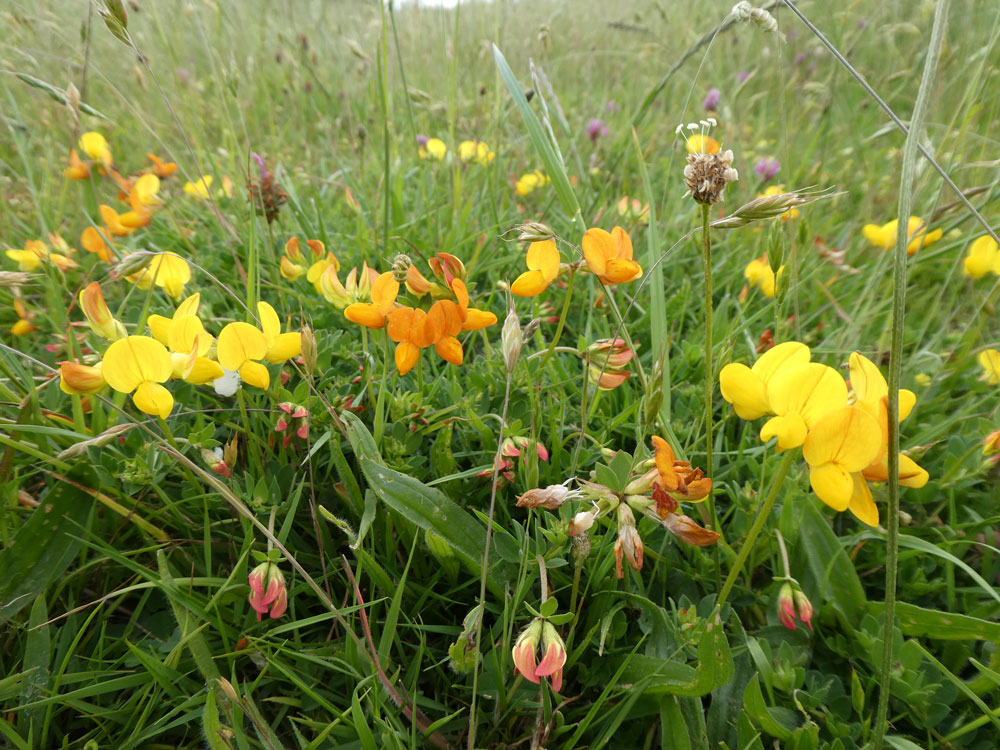
Bird’s-foot Trefoil
In the early years, the Bird’s-foot Trefoil flowers were all yellow and I thought we had been sold some continental seed but now its all ‘eggs and bacon’ just as it should be.
This little lass is rather striking isn’t she? (Not a patch on Tannavi though!) It’s Urophora stylata, a picture-winged fly of the family Tephritidae.
Urophora stylata
The black extension of the abdomen is an ovipositor which they use to lay their eggs in plant tissue often resulting in gall formation. I believe this one likes thistles though it was resting on a willow-herb.
I like it when a photo comes out as I had hoped. This shows the female flowers at the top and the largely spent male flowers at the bottom on an inflorescence of Salad BurnetPoterium sanguisorba. The ones in between are bisexual.
Nothing can better four hours in the company of Tannavi and the nature to be found at this terrific little nature reserve other than more hours.
Quaking-grass
Briza media is a lovely distinctive grass with spikelets that dance and tremble. It is not at all common generally except on basic soils and it is very frequent here.
I’ve visited this Notts Wildlife Trust reserve on several occasion as have many other naturalists and botanists so I’m pleased to have found a first for the site (if BSBI maps are anything to go by) in the form of Sulphur CinquefoilPotentilla recta.
Sulphur Cinquefoil
As the day warmed up (we were on site by 7:15) the invertebrates gained our attention and several Burnet Companions were the highlight among these.
Burnet Companion on Hay-rattle
Tannavi is beautiful and clever and delightful – here she is photographing a Burnet Companion and her photos are much better than mine.
Five hours of magical mystery, touring eastern Rushcliffe’s Barn Owl boxes with Howard and Tannavi our new assistant owler. The boxes continue to turn up large clutches and we ringed five that were big enough near Aslockton where we were joined by photographer Lionel Reyes. He has taken many very fine shots of the owls, such as the one below and others can be viewed on his Flickr site under Lionel Gibraltar.
Barn Owl by Lionel ReyesL-R Howard Broughton, Tannavi Kumar and Neil Pinder
An hour long trek to a very remote part of Nottinghamshire for another day of botany et.al. and a very nice find to round it off. But we began with the routine bagging of everything we could spot and finished on 213 species of plant, 10 of butterflies and 3 moths; several Cinnabars and Yellow Shells plus a Silver Y.
A few days earlier I had done my butterfly transect and only got three species so ten on a rather blustery day suggest that the late May lull is over. They included our first Large Skippers and a Red Admiral.
Large Skipper
Among the more notable for me at least, as I am a reluctant traveller these days so I don’t see plants that like light soils much, was BuglossAnchusa arvensis. Also-rans include Wild MignonetteReseda lutea.
BuglossWild Mignonette
Plant of the day looked like Herb Robert to me but Dave’s experienced eye suggested to him something different and a quick dip into Stace led us to Little RobinGeranium purpureum and there was lots of it.
There is only one previous Nottinghamshire record, made over 20 years ago near Worksop and its stronghold is in north Cornwall.
For interest, I heard via a devious route that Mike Hill has recorded Light Knot-grass at Netherfield. I understand this is the first record since larvae were found in the county in 1858 and 1897! Its ‘strongholds’ are Wales, NW England and northern Scotland.
By this time last year the sown wildflower meadow at the burial ground was rampant with False Oat Grass and hardly anything in the way of the desirable plants were showing. It seemed that the diversity had seen a relentless demise. Over the winter however, the neighbouring sheep had been allowed to graze and I only turned them out about two weeks ago at which time the only plants with any height were Nettles which have colonised some of the drier areas on the old ridges though the sward obviously held quite a diversity. Today I was delighted to see some of the introduced plants maturing and Ragged Robin, Hay Rattle, Hairy and Smooth Tare, Common Vetch and Bird’s-foot Trefoil for example were all flowering. It seems though that the once dominant Ox-eye Daisy and Yorkshire-fog are much declined and Soft Brome is now dominant.
Mother Shipton
The best thing though, as it indicates good grassland habitat was this Mother ShiptonEuclidia mi– I have only seen them before at East Leake Station and a few other places but it is nice to know that they have found Keyworth – I’m guessing it’s a first for the village in many decades.
This was a first for the village last year:
Thorow -wax
Bupleurum ovalifolium used to grow as a cornfield weed though it was very rare by the time of the ‘latest’ flora of Nottinghamshire (1963) when it was known from three sites in the county and it is now extinct as a wild plant in Britain. This plant originates from a sown or planted border nearby, whose parents had managed to jump the cultivation. There is I think, just the one plant, so it may be the last. It used to be called Hare’s Ear though the name Thorow-wax originates from 1548 when William Turner wrote that the “stalke waxeth thorowe the leaues”.
A rather noisy day spent along the A52 with a visit to a square bordering Leicestershire and a revisit to Elton on the Hill itself to fill in some gaps on the atlas and that was achieved with some success. The sun shone intermittently during the morning and Common Blue and Small Copper made brief appearances and a Dock BugCoreus marginatus and Wasp BeetleClytus arietus caught our attention.
Dock BugWasp Beetle
NBN Atlas for Dock Bug suggests we are pretty much at the northern edge of its range. The Wasp Beetle is in the Cerambycidae – the longhorn beetles but this one’s aren’t especially flamboyant.
The A52 verge had been unnecessarily mown over its full width but some plants were still managing to flower including a striking patch of Ragged RobinLychnis flos-cuculi.
Ragged Robin
This are also held several small populations of Bur ChervilAnthriscus caucalis with its hooked hairs on the fruits.
Bur Chervil
It’s quite easy to overlook galls when the primary purpose is to find as many species of plant as possible but when Dave’s beady eyes are on the case, I allow myself the occasional diversion. This is the gall of the aphid Cryptosiphum artemisiae on Mugwort.
Gall of Cryptosiphum artemisiae on Mugwort.
BuckthornRhamnus cathartica is the plant that Brimstone butterflies use as a food plant but this one showed no sign of any munching. I find it mildly strange that the butterfly seems to occur everywhere but the food plant is rather local. On the other hand some of the scarcest butterflies use food plants that are abundant and widespread.
Buckthorn
ElderSambucus nigra is not a very long-lived plant but this one looks to be as ancient as they get.
Elderly Elder
Plant of the day came right at the end as the rain and chilly breeze got going. Round-leaved CranesbillGeranium rotundifolium would definitely have passed me by. I still have to look very carefully at many Geraniums to decide on a name and this one’s jizz did not jump out as being anything special (except the leaves were held at an odd angle – though that is not a identification criterion) but it did have the red-tipped glandular hairs on the petiole (leaf stalks).
Round-leaved Cranesbill
It is a Nottinghamshire Rare Plant Register species which points out that although it is native in southern Britain, it is introduced here and it occurs on dry waste ground.
In amongst the predictable Shuttle-shaped Darts and Heart and Darts was this nice surprise; a Maiden’s Blush – my second ever (the first was on 6th August 2008).